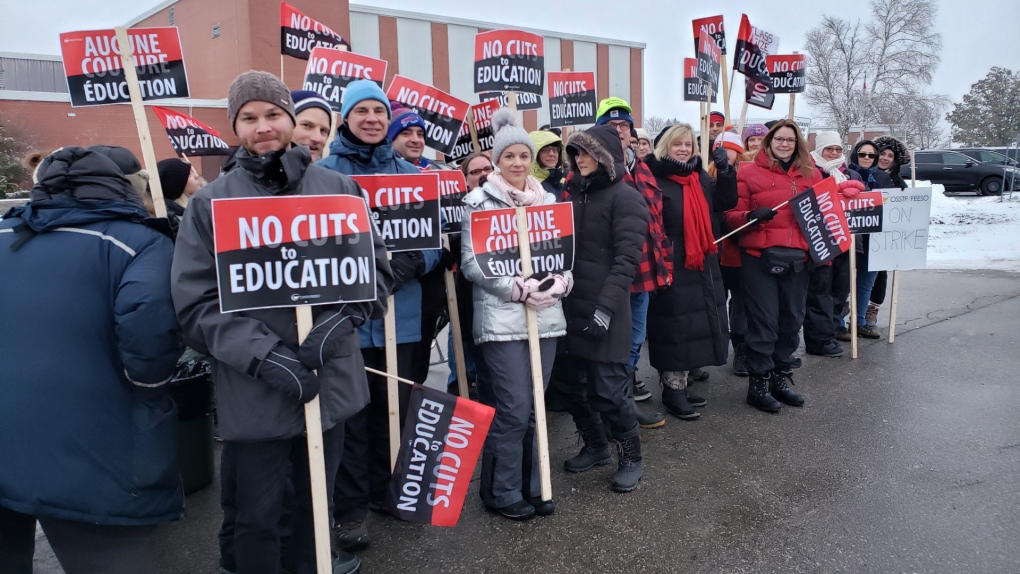
Doug Ford’s government has recently made cuts to the Ontario education system resulting in larger class sizes, reduced staff and reformed curriculums. As a result, all four Ontario teachers’ unions are currently engaging in some form of job action in protest. As the Teachers Union collective agreement has reached maturity, and a new contract must be negotiated, many teachers and federations have capitalized on this time to strike on the recent changes. Work-to-rule, rotating strikes, and province-wide walkouts are the responsive actions that have been taken by the unions over the past few months. The Elementary Teachers’ Federation of Ontario (ETFO), the union which represents 83,000 elementary school teachers across Ontario, said it would continue its rotating strikes into the second week of February if a deal with the government were not reached. This would include another one-day province-wide strike on February 11th1. Though many may argue that the core reason of the strike is teachers wanting “higher pay raises and job security”, the excess amount of salary foregone by the strikes in recent months prove that the teachers are genuinely moving for the rights of the students and their education.
City officials still say the primary reason the strike has dragged on is that a team of 45 rank-and-file teachers are holding up negotiations. They say the union’s top leadership, which is elected, has to take each of the offers back to this team for approval before the offers can be voted on by the entire membership2. Consequently, many extracurricular programs and offerings have been put on hold and teachers have been asked to assume a work-to-rule position. As teachers have moved into this “work-to-rule” standpoint, they have now only the responsibility to perform the bare minimum requirements of their jobs and will do no further value-adding actives. In a work-to-rule, teachers typically eliminate after-school activities, shutting down sports teams, field trips, clubs, music programs, student councils, and sometimes cancelling graduation ceremonies. Teachers also have refused to add comments on report cards or conduct the province’s standardized tests. For many of the high school systems currently, students will receive no report card at all and will simply be told their final grade directly by the teacher. For students applying to university and colleges, this has created a tremendous amount of challenges.
Moreover, without the supervision and presence of teachers, 24% of the Canadian population (citizens ageing 3-18) would be left without proper arrangements3. To compensate for the absence of school supervision, the government is spending upwards of $48 million a day to compensate for teacher strikes. Sam Hammond, the President of the ETFO, describes these payments as a ‘bribe’ to affected parents. Sam Hammond spoke further on the current issue between the Ontario Government education cuts and the ETFO. He stated that the teaching positions to support special education students, Indigenous students, at-risk students and English language learners would receive half the funding they currently have4. Currently, it looks as though the only way the Ontario Government will increase funding is if Teachers Unions and Federations are willing to make cuts in other areas.
Works Cited:
- The Council of Ministers of Education, Canada. (2018, September 30). Council of Ministers of Education, Canada. Retrieved September 21, 2019, from https://www.cmec.ca/299/Education-in-Canada-An-Overview/index.html
- CBC News. (2020, January 15). Ontario public elementary school teachers set to begin rotating strikes on Monday Social Sharing. Retrieved February 7, 2020, from https://www.cbc.ca/news/canada/toronto/etfo-public-teachers-strike-1.5427368
- Government of Ontario. (2018, December). Education Facts, 2017-2018 (Preliminary). Retrieved February 15, 2020, from http://www.edu.gov.on.ca/eng/educationFacts.html
- Alphonso, C. (2020, February 5). Head of Ontario teachers union says Ford government bid to alter supply-teacher hiring rule derailed talks. Retrieved February 15, 2020, from https://www.theglobeandmail.com/canada/article-head-of-ontario-teachers-union-says-ford-government-bid-to-alter/
 Mackenzie Hinshelwood - EMPR200
Hi Mackenzie,
I agree with your stance regarding how these recent strikes underway by Ontario’s Teacher Union. It’s a difficult situation for both parties because, on the one hand, teachers deserve considerable remittance for their work, however, it shouldn’t be at the expense of the educational enrichment of our youth.
What really resided with me in this report was the fact that “24%” of the Canadian population will be affected by this absence of school presence. Fortunately, I have never experienced a teacher strike long enough to inflict serious repercussions, although I do still feel for the students affected by this extenuating circumstance.
One idea I might bring up is, what do you believe is the best course of action for the government to take in order to mediate these problems? Additionally, are the teachers just in their actions to seek more value and compensation for what they do every day?
I look forward to hearing from you.
-Jack Perry
LikeLike
Hi Jack,
Thank you for your comment, you gave some very good insight on the topic.
To answer your questions, I believe that Canadian families rely on teachers in immeasurable ways. Thus, it is crutial that the teachers of Canada uphold their teaching duties. Education is one of the main pillars of our society, and a right for all children to have up until graduation of highschool, so to take this away in unfair to Canadian youth. Addressing your second question, I believe this strike comes from a place of wanting a better learning environment for students, but having budgetary cuts. Compensation is playing a role in this dispute, but I do not believe it is the underlying cause.
Cheers,
Mackenzie
LikeLiked by 1 person
Hi Mackenzie,
I really appreciate how you have exemplified and incorporated the importance of extracurricular activity impacts of a provincial wide school strike.
As teachers move towards the “work- to- rule” of their jobs, it without a doubt decreases the value of school in general. I believe that these after school activities that are facilitated by the teacher union members are a crucial part of development and learning. With a shut down of sports teams, field trips, drama club, music programs, and governing bodies such as student council it definitely becomes an impediment to not only the well being of students but the stakeholders of the school board. Students are not able to apply classroom knowledge into real-life scenarios and such as problem-solving skills and communication skills.
To bring up a personal experience. The year I was graduating middle school (2014), BC had their provincial wide teachers strike. We had to organize our own graduation and the parents of students had to take time out of their working hours to facilitate an environment where students could go and still enjoy what was supposedly a milestone in their educational life.
Although it is a difficult question to answer, but do you think that there is a better alternative than a public strike for teachers to exemplify their frustration and boycott the educational system?
Looking forward to it,
Alyssa Lee
LikeLike